If this is your first time to order cowboy boots, please understand that cowboy boots fit a little different than regular adjustable shoes. Cowboy boots don't adjust like shoes with elastic or laces. Don't worry, we have fitted thousands of customers using this method.
Handmade Cowboy boots made by different manufactures will all fit a little different. Boots are made on lasts (Nylon or wood shaped foot) and all of them are slightly different for each boot maker. Hand made boots of the same size and same manufacturer will vary slightly as well. This is due to different thickness and strength of each natural leather and other factors such as humidity and the boot makers strength on a particular day, as well as the toe style.
If after following the steps in this guide you are still not sure of your size, then the best way to get a boot that fits is to send us a boot that fits well then we will match a last to that boot. We’ll send the boot back to you after we have determined your correct size.
How to determine your size for your new Cowboy Boots from Timsboots.com
 You can measure your feet to determine your size by following this guide. DO NOT try to guess or order your tennis shoe size, or even the size of another boot manufacturer. We have had success in fitting more than 98% of our customers right out of the box, so this method works. We’ll be happy to work with you to get a boot that fits.
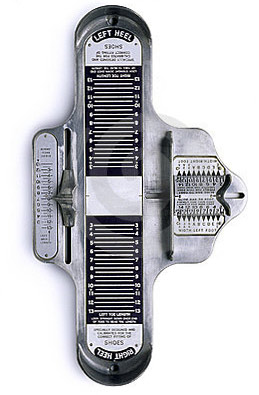
The US size system uses numbers to indicate the length and letters to indicate the width. The Brannock Device you would find at any good shoe store is commonly used to measure sizes in the USA. The size system is linear. Men's size 1 is 7 2/3 Inches long and each additional size is 1/3 Inch longer.
There are 9 widths in the US system. From narrowest to widest, they are: AAA, AA, A, B, C, D, E, EE, and EEE. The D width is considered to be "medium" for men and B width for women. The widths are linear and are separated by 3/16 of an inch however the actual width measurement which yields a D width varies with the length.
How to measure your foot to find its size & width
You can determine your boot size and width using the following instructions and the tables below.
You'll need:
- A sheet of paper on which to trace an outline of your foot. (A file folder works well)
- A regular wood pencil. (Do not use pens or markers or mechanical pencils)
- A measuring tape or ruler.
- The type socks you intend to wear with the cowboy boots.
Notes:
- Feet swell slightly and get larger during the day, so measure later in the day.
- Left and right feet many times are a little different in size. Measure both feet and use the measurement for the larger foot.
- If sending in, do not Fax tracings! The fax will resize the tracing rendering it useless.
- Please have a friend do the tracing – don’t attempt to do your own. *See tip below.
Follow these steps for each foot
- You must be sitting with your foot on a piece of paper or cardboard big enough to make a drawing around your foot. File folders are great.
- Draw the outline of your foot with the pencil held perpendicular to the paper at all times. Be sure to hold the pencil snugly against your foot.
- Measure the length and width at the points shown in the drawing.

- The drawing will be a little larger than your foot because of the pencil thickness. Subtract 0.2” from each measurement. This will give you a more accurate length and width.
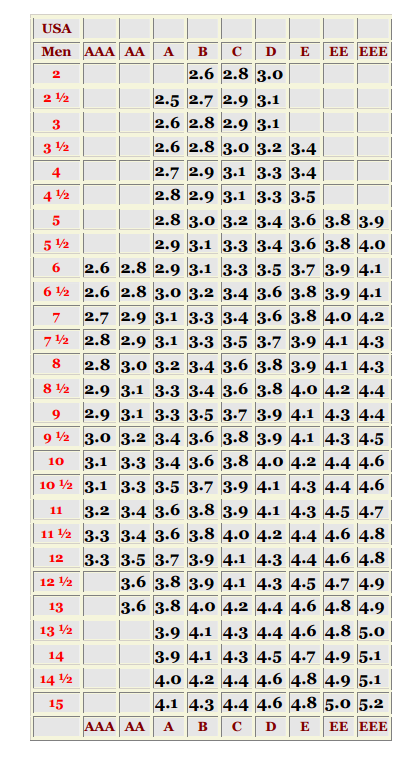
- Look on the boot length chart and find the Men's US size. Next go to the Boot Width Chart with the Men's US size and find the closest width measurement on that row.
- Please also let us know if your instep is High, Medium or Low. If your instep is high or low, you probably already know this. If you don't know, you most likely have a medium instep.
Notes:
- If you don't have someone to help with the tracing, many customers have found that you can put your foot between two flat, solid objects such as large books or bricks and then measure the length between. Do the same for the width. Do this for both feet. You do not need to subtract anything for the pencil thickness using this method.
- If unsure always go up in size and width, it's much easier to adjust too big of boots than too small of boots. Thick Socks and or padded insoles.
- Sizer Boots are available for most sizes & Toe and Heel Combinations for an extra charge.
- We recommend ordering a less expensive boot rather than an expensive exotic if you are unsure of your size.
Sizing Charts
Boot Length Chart
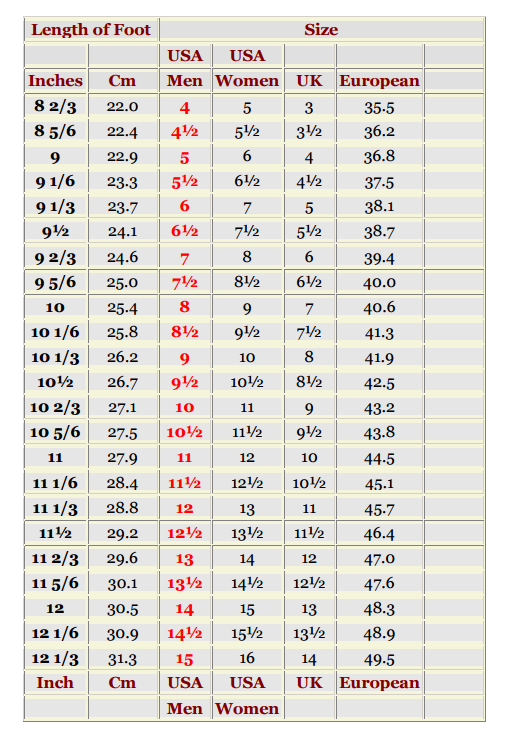
- Sizes are Men's except as noted
- European sizes are usually whole numbers. In this chart they have been interpolated to show their closest match to USA men's sizes.
- To convert from centimeters to inches, divide by 2.54
Boot Width Chart
- USA Men’s Size is along the left. Go to the row for your size then find the width (in inches) on that row.
- The column head gives the width. To convert from centimeters to inches, divide by 2.54.